The Stranded Asset: Why a Dry Building is Still a Financial Risk
Mar 19, 2026 @ 17:11
- by Premkumar SCommercial property insurance premiums in Florida have reached a tipping point, with some sectors seeing spikes higher than ever. This isn’t just a reaction to recent storm seasons; it is a fundamental shift in how risk is priced. For the first time, the way property is insured has split into two distinct, diverging tracks.
Understanding the gap between these tracks is the difference between a secure investment and a stranded asset.
The Great Underwriting Divergence
The market is currently operating under two different sets of logic.
On one side is Track 1: Surgical Structural Assessment. This is the logic used by programs like FEMA’s Risk Rating. It is high-resolution and asset-specific. It looks at your foundation, your specific elevation, and your individual mitigation efforts. It rewards owners who invest in their properties, moving away from neighborhood-wide averages to focus on the individual building.
On the other side is Track 2: The Zonal Exit Strategy. This track is where Sea Level Rise (SLR) lives. Unlike flood risk, which is viewed through the lens of structural damage, SLR is viewed by insurers through the lens of zonal-based “insurability thresholds.” If a general area looks uninsurable over a decadal timeline, carriers begin their exit strategy today, either through aggressive premium hikes or non-renewals.
The danger for property owners lies in the “Accuracy Gap.” If your building is on high ground but is caught in a macro-level “red zone” based on outdated regional data, you are being unfairly penalized. You are paying an “uncertainty tax” for a risk you do not share.
The Anatomy of a Stranded Asset
A building does not exist in an Isolation. It exists as part of a network of roads, utilities, and access points. At AssetRX, we advocate for a shift in perspective: A property is only as valuable as its connectivity.
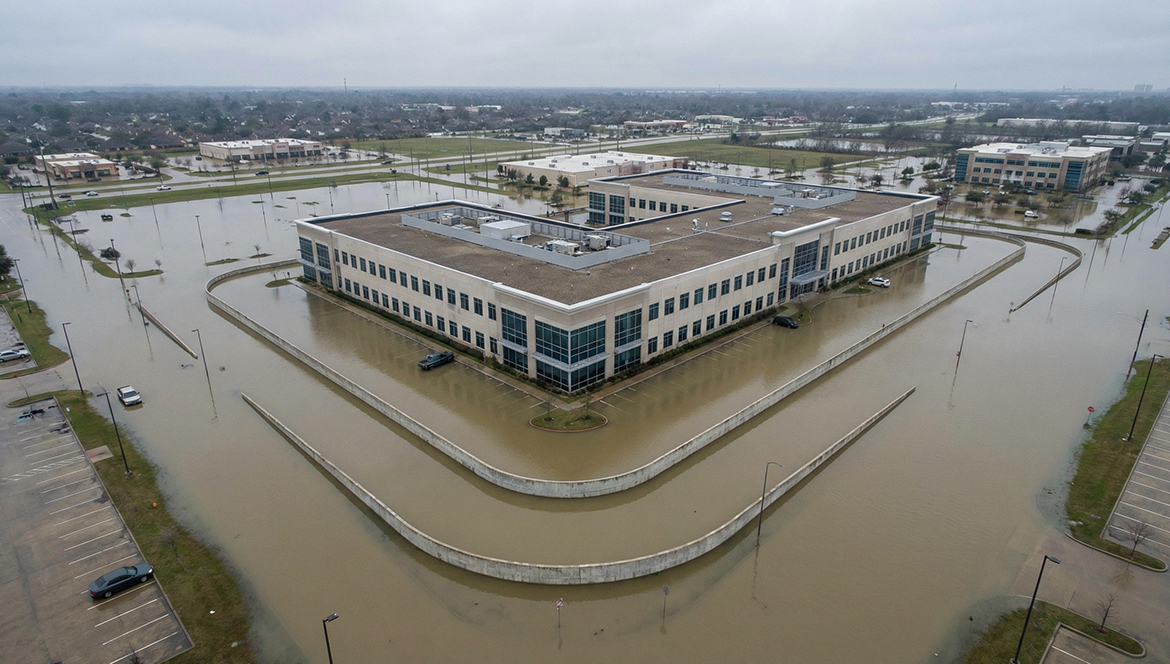
We identify the “Accessibility Threshold” as the exact moment when a building remains structurally dry, but its lifelines are severed. This creates a Stranded Asset. A property might be safe from direct inundation, but if the primary access roads are submerged 15 days a year, the building is functionally isolated.
When tenants cannot reach the office, employees cannot park, and supply chains are broken, the asset’s liquidity vanishes. The market value begins to erode long before the first floor gets wet. Most traditional risk models miss this entirely because they stop at the building’s walls. AssetRX utilizes Dual-Impact Analysis to synchronize the building and the road network on a single timeline, transforming “flood risk” into “operational risk.”
Precision at the Pixel Level: Beyond Elevation
Elevation is often treated as a silver bullet for risk mitigation, but elevation is a static number in a dynamic coastal environment. Two buildings with the same foundation height face vastly different futures based on their proximity to the water and the physics of the coastline.
To solve this, we apply a Distance Decay Factor (DDF) to every building. This model recognizes that assets directly on the shoreline face significantly higher structural threats, such as storm surge velocity, wave pressure, and salinity-driven erosion, compared to assets just 500 meters inland. Even if the water depth is identical, the kinetic energy is not.
Furthermore, we look at Perimeter Vulnerability. It isn’t just about what is under the roofline; it’s about the pressure on the property boundaries. By calculating the Wet Perimeter Ratio, we track the percentage of a property boundary that is submerged over time. This metric provides a clear, incremental look at a property’s “island effect” as it transitions from coastal-adjacent to water-locked.
Scenario-Driven Forecasting (SSP Integration)
Climate risk isn’t a single data point; it’s a spectrum of possibilities. AssetRX utilizes global Shared Socioeconomic Pathways (SSP) frameworks to model these possibilities. By localizing these global projections, we help users answer a critical fiduciary question: “Is this property safe under a moderate-emissions future, but a total loss under a business-as-usual scenario?”
Our platform allows stakeholders to toggle between scenarios (such as SSP 4.5 and SSP 7.0) across a decadal slider from 2030 to 2090. This level of detail is essential for Capital Expenditure (CapEx) planning. Spending millions on seawalls for a risk that doesn’t hit a critical threshold until 2060 is a waste of capital. Conversely, ignoring a 2040 “Nuisance Flooding” threshold is a recipe for asset decay.
The Regulatory Shield: Meeting the OIR Mandates
The Florida Office of Insurance Regulation (OIR) has implemented stricter reporting and disclosure mandates for the 2024–2025 cycle. Insurers are now required to integrate more granular climate data into their underwriting platforms to justify their pricing.
Macro-level generalizations are no longer acceptable. The “Ground-Up Truth” provided by AssetRX acts as a scientific evidence package. Our Normalized Risk Score (1–100) provides a consistent benchmark that allows for a fair comparison between different asset classes and locations. It translates complex variables of inundation depth, connectivity loss, and distance decay into a universal language that investors, insurers, and regulators all speak.
Conclusion: Define Your Risk or the Market Will
In a hardening insurance market, uncertainty is a financial liability. When data is blurry, underwriters price for the worst-case scenario. The only way to negotiate a fair rate and protect asset liquidity is through site-specific, validated precision.
AssetRX was built over two years in collaboration with scientific experts to provide this level of certainty. We don’t just predict the water; we map the operational future of the asset. Don’t let your high-ground property subsidize a regional average. Define your risk with the ground-up truth.
Explore the AssetRX Platform and Request a Custom Building-Level Report.