Sustainable AI in Action: How Reusable Logic Blocks Save More Than Just Time
Apr 7, 2026 @ 12:45
- by adminTGXWe need to talk about the hidden cost of the “messy middle” in spatial data engineering.
When we discuss the infamous 80/20 trap, the reality that geospatial professionals spend 80% of their time cleaning data and only 20% performing actual science, we usually frame it as a productivity problem. We talk about the burnout of highly qualified experts acting as digital janitors. We lament the delayed project timelines and the frustration of fighting legacy desktop applications.
But there is another, much higher cost to this inefficiency, one that rarely makes it onto a balance sheet but has profound implications for our industry and our planet.
Every single time a GIS professional rewrites a standard data-cleaning script, recreates a projection transformation, or manually engineers a spatial join that a colleague in another department has already perfected, immense amounts of energy and computing power are wasted.
In an era where massive datasets and heavy processing define our work, redundancy is no longer just an administrative annoyance. It is an environmental and architectural flaw. To fix it, the spatial industry must embrace Sustainable AI and the power of logic reuse. We need to stop scaling our compute and start scaling our knowledge.
Here is how the shift to modular GIS is building an architecture of certainty, reducing the carbon footprint of spatial analysis, and allowing enterprise innovation to compound.
The Invisible Carbon Footprint of Spatial Analysis
Geospatial data is inherently heavy. Whether we are dealing with high-resolution satellite imagery, multi-layered climate resilience models, or granular parcel data for risk assessment, the sheer volume of information processed daily is staggering.
Historically, the workflow for handling this data has been highly individualized and deeply siloed. Consider a large insurance company tasked with assessing flood and wildfire risks across millions of properties. In a traditional setup, the catastrophe modeling team might download terabytes of raw topological and weather data, write custom Python scripts to clean and standardize it, and run heavy raster calculations on local machines.
Meanwhile, just down the hall, the underwriting analytics team might need a slightly different cut of that same data to price a new commercial policy. Because the first team’s workflow is locked away in a localized desktop environment or an undocumented script, the second team starts from scratch. They re-download the same massive datasets. They rewrite the same ingestion scripts. They run the same geoprocessing tools.
The servers spin up. The processors run hot. The carbon footprint of the organization quietly expands.
Every redundant process requires electricity. Every time a massive file is duplicated across local hard drives instead of being referenced in a cloud-native environment, storage infrastructure swells. When AI is introduced into this legacy paradigm, the problem often gets worse. Many modern platforms rely on Large Language Models (LLMs) to generate new, unverified code from scratch for every single user query. Generating code via LLMs is highly compute-intensive. Doing it repeatedly for the same routine geospatial tasks is the antithesis of green tech.
Enter the Logic Block: The Building Blocks of Modular GIS
At GriidAi, we recognized early on that throwing more raw compute power at the 80/20 trap was not a sustainable solution. The goal isn’t to make the “data janitor” work happen faster by burning more server energy; the goal is to eliminate the need to do it twice.
This is where the concept of the “Logic Block” comes in.
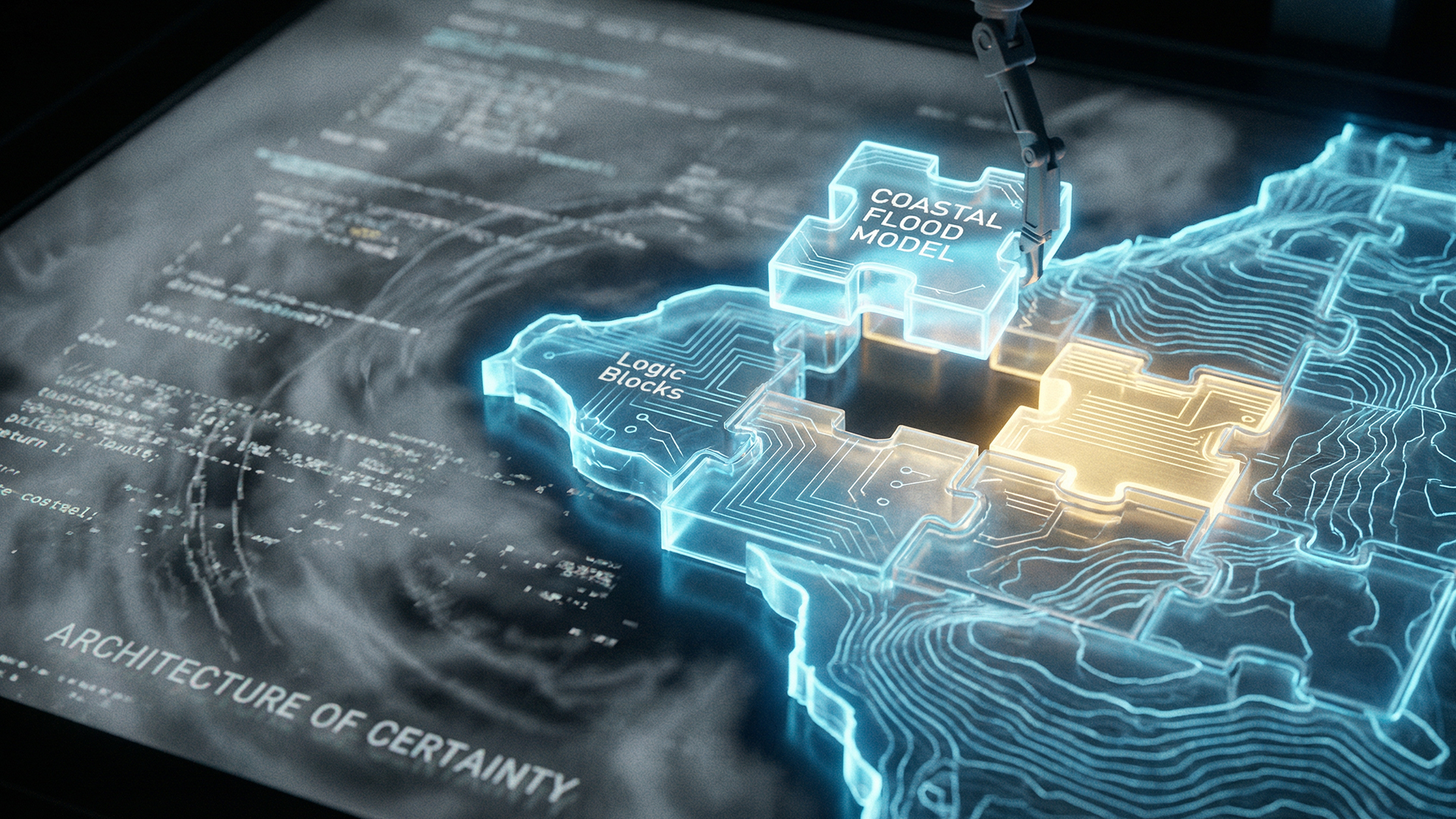
A Logic Block is a foundational piece of modular GIS. It is a discrete, pre-validated workflow or spatial operation that has been encapsulated into a single, reusable asset. Instead of writing a new script to standardize coordinate reference systems (CRS) or to clean messy CSV files containing property coordinates, a professional can simply orchestrate a proven Logic Block to handle the task.
Through GriidAi’s human-centric, no-code platform, users interact with these blocks using natural language. You declare your professional intent—for example, “Ingest this open-source flood plain data, standardize the projection to match our internal property database, and output the risk intersections.”
Behind the scenes, the GriidAi engine doesn’t blindly guess or generate volatile new code. It acts as an orchestrator, retrieving the appropriate, pre-engineered Logic Blocks to build a detailed execution plan. Crucially, the system requires the human expert to review and validate this plan before execution.
This approach completely changes the energy dynamics of spatial analysis. By relying on an architecture of logic reuse, GriidAi minimizes the need for compute-heavy code generation. We use AI to orchestrate and retrieve, rather than to hallucinate and guess. We call this philosophy “tools over tokens.” It ensures that we use less AI where it doesn’t help, and provide more reliability where it matters most.
Compounding Innovation: Scaling Knowledge Across the Enterprise
The true beauty of modular GIS is that it transforms isolated expertise into organizational infrastructure.
Let’s return to the insurance company example. When the catastrophe modeling team uses GriidAi to build a complex workflow for analyzing coastal erosion impacts on commercial real estate, that workflow doesn’t have to die on a local hard drive. Once validated, that workflow can be saved as a custom Logic Block and shared securely across the organization.
The next week, when an underwriter needs to run a similar analysis, they don’t start from a blank screen. They leverage the pre-built Logic Block.
This is what we mean by compounding innovation. In traditional GIS, an organization’s capability is only as high as the individual operator’s scripting skills and hardware limits. Knowledge is siloed, and every new project starts at zero. In a modular ecosystem, every solved problem becomes a permanent stepping stone. The baseline of what is possible rises for the entire team.
When a spatial architect builds a solution once and shares it, the entire enterprise benefits. Complex data engineering tasks that used to take three days are reduced to a few clicks, not because an AI guessed the right answer, but because a human expert mapped the route and paved the road for everyone else.
This shift moves the professional from being a “Tool Operator” to a “Spatial Orchestrator.” You are no longer spending your energy figuring out how to force the machine to process the data; you are directing the system to execute verified logic at scale, freeing you to focus on the why of the spatial insight.
Sustainable AI is the Future of the Craft
Sustainable AI is not just a buzzword; it is an operational imperative for the future of geospatial science. As the demands on our data grow—driven by urgent global challenges like climate change, rapid urbanization, and complex risk modeling—we cannot afford tools that waste our two most precious resources: human expertise and environmental energy.
A platform built on logic reuse fundamentally lowers the total cost of ownership. It reduces the dependency on high-end local hardware, cuts down on expensive redundant cloud compute fees, and most importantly, it reclaims the thousands of hours lost to the 80/20 trap.
By eliminating setup, storage, and maintenance friction, GriidAi allows insurance companies, risk modelers, and GIS professionals to focus entirely on the science of location. We are building an ecosystem where less computing power yields higher certainty, and where the brightest minds in the industry can finally stop fighting their legacy workflows.
Breaking the Bottleneck
The era of the digital janitor is ending, and the era of the Spatial Orchestrator is here. It is time to transition away from brittle scripts, redundant processing, and massive hardware constraints.
By embracing a platform designed around reusable intelligence, we can build a future where innovation is shared, compute is optimized, and our daily work directly contributes to a more sustainable, resilient world.
The bottleneck is breaking. If you are ready to elevate your team’s spatial analysis, reduce your redundant compute load, and experience the power of compounding innovation, it’s time to see what’s on the other side.
We are currently granting early, complimentary access to a select group of geospatial leaders and enterprise risk professionals to help shape the future of the GriidAi platform. Discover how our no-code orchestration engine can transform your workflows today.